
Unmanned aerial vehicles (UAVs) are increasingly deployed in environments characterized by high mechanical stress, airborne particulates, humidity, and rapid temperature variation. These conditions impose strict requirements on optical interfaces that protect onboard sensors while preserving imaging and signal transmission performance.
Customized sapphire windows, made from single-crystal aluminum oxide (Al₂O₃), have become a widely adopted solution due to their superior mechanical strength, broad optical transmission range, and high chemical stability. This article presents a scientific overview of sapphire windows in UAV optical systems, focusing on material properties, functional roles, and engineering design considerations.
1. Giriş
Modern UAV platforms integrate multiple sensing modalities, including visible imaging cameras, infrared thermal sensors, and laser-based ranging systems. These sensors rely on a front optical interface that must simultaneously provide:
- Physical protection from environmental exposure
- High optical transmission with minimal distortion
- Long-term stability under continuous flight conditions
The optical window is therefore a critical subsystem component rather than a passive cover element.
Conventional optical glass materials can suffer from surface abrasion, haze formation, and reduced transmission when exposed to sand, dust, or salt-rich environments. Sapphire has emerged as a high-performance alternative for demanding UAV applications.
2. Material Basis of Sapphire Windows
Sapphire is a single-crystal form of aluminum oxide (Al₂O₃) with a hexagonal crystal structure. Its intrinsic physical properties are responsible for its suitability in harsh optical environments.
| Mülkiyet | Tipik Değer | Engineering Relevance |
|---|---|---|
| Sertlik | Mohs 9 | Mükemmel çizilme direnci |
| Erime Noktası | ~2050°C | Yüksek termal kararlılık |
| Optical Transmission Range | ~0.15–5.5 μm | UV to mid-infrared compatibility |
| Kimyasal Stabilite | Çok yüksek | Resistance to corrosion and oxidation |
| Mekanik Dayanım | Yüksek basınç dayanımı | Suitable for high-impact environments |
Unlike polycrystalline ceramics or standard optical glass, sapphire exhibits low defect propagation and stable optical properties under prolonged environmental stress.
3. Functional Role in UAV Optical Systems
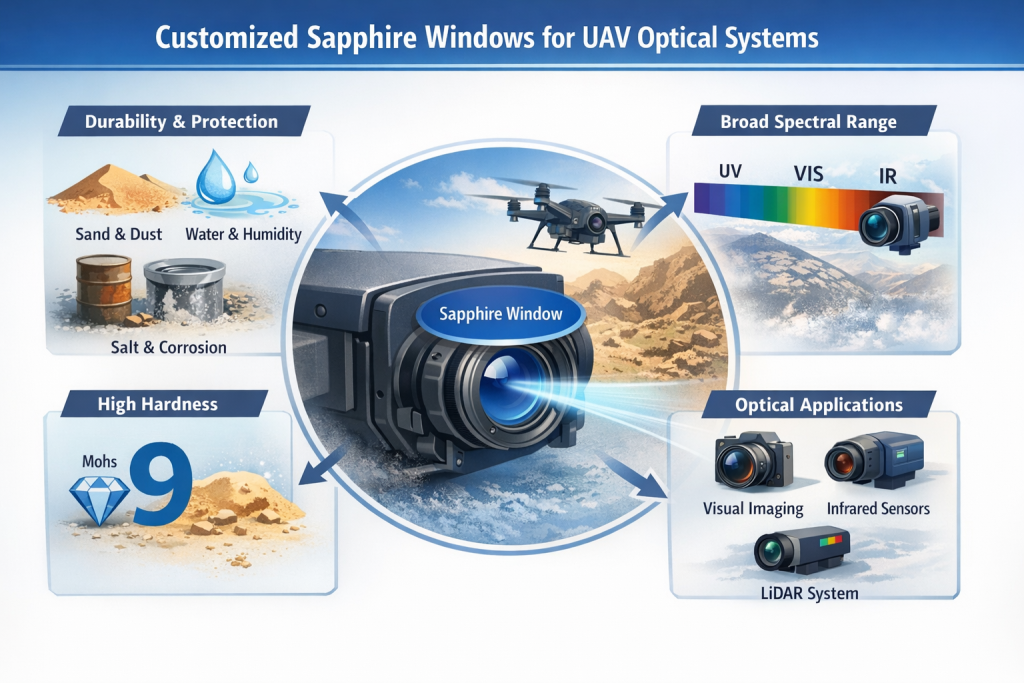
A customized sapphire window serves as a protective and optical interface layer between the external environment and the sensor system.
3.1 Environmental Protection Layer
It isolates sensitive optical sensors from:
- Dust and sand particles
- Rain and humidity
- Salt fog in marine environments
- Chemical contaminants in industrial areas
3.2 Optical Transmission Interface
The material supports high transmission efficiency across multiple spectral ranges, enabling compatibility with:
- Visible imaging systems
- Near-infrared (NIR) sensors
- Short-wave infrared (SWIR) and selected thermal imaging systems
3.3 Mechanical Protection Element
It resists surface damage caused by:
- High-speed airflow erosion
- Particle impact during flight
- Handling and maintenance wear
4. Performance Advantages in UAV Applications
The integration of sapphire windows into UAV systems provides measurable engineering benefits:
4.1 Improved Optical Stability
Surface hardness reduces micro-scratch formation, which otherwise increases scattering and reduces image contrast.
4.2 Enhanced Signal Quality
Stable optical surfaces help maintain consistent signal-to-noise ratio (SNR) in imaging and sensing systems.
4.3 Extended Operational Lifespan
Reduced degradation under abrasive and corrosive conditions improves long-term system reliability.
4.4 Suitability for High-Speed Platforms
Sapphire maintains structural integrity under aerodynamic pressure and particle impact encountered in high-speed UAV flight.
5. Customization Parameters
Sapphire windows for UAV applications are typically engineered according to system-level optical and mechanical requirements.
| Parametre | Engineering Range | Functional Impact |
|---|---|---|
| Kalınlık | 0.3–5 mm | Balances strength and optical transmission |
| Yüzey Pürüzlülüğü | < 5 nm (Ra) | Affects imaging clarity and scattering loss |
| Optik Kaplamalar | AR / IR-enhanced multilayer coatings | Optimizes wavelength-specific transmission |
| Geometry | Circular / rectangular / custom shapes | Integration with sensor housing |
| Edge Treatment | Polished or chamfered edges | Reduces stress concentration and fracture risk |
Advanced polishing and thin-film coating technologies are essential to achieve high-performance optical behavior.
6. Engineering Considerations
While sapphire provides excellent performance, its integration into UAV systems requires careful engineering consideration:
- Brittleness under extreme point loading: Although hard, sapphire is still a brittle single crystal and requires proper mechanical mounting design.
- Cost and machining complexity: Precision cutting and polishing increase manufacturing complexity compared to standard glass.
- Coating durability: Optical coatings must be designed to maintain adhesion under thermal cycling and vibration.
- Thermal expansion matching: Mechanical interfaces should accommodate differences in thermal expansion coefficients to avoid stress accumulation.
These factors are critical in ensuring reliable long-term performance in field conditions.
7. Future Development Trends
The use of sapphire windows in UAV systems is expected to expand alongside advancements in aerial sensing technologies:
- Lightweight ultra-thin sapphire optical windows for long-endurance UAVs
- Multi-band optical windows supporting sensor fusion (visible + IR + LiDAR)
- Enhanced anti-reflective and anti-fouling coating systems
- Integration into autonomous inspection and AI-driven imaging platforms
As UAV missions become more data-intensive and environmentally demanding, optical window materials will play an increasingly important role in system-level performance optimization.
Sonuç
Customized sapphire windows provide a scientifically robust solution for protecting UAV optical and sensing systems in harsh operational environments. Their combination of extreme surface hardness, broad spectral transmission, and chemical stability makes them a critical enabling material for high-reliability aerial imaging systems.
With continued advancements in precision machining and optical coating technologies, sapphire windows are expected to remain a key material in next-generation UAV optical architectures.