
1. Inledning
Sapphire (single-crystal Al₂O₃) is widely used in advanced optical systems due to its exceptional combination of properties:
- Extremt hög hårdhet (Mohs 9)
- Excellent chemical resistance
- Hög termisk stabilitet
- Wide optical transmission range (UV to mid-IR, ~0.15–5.5 μm)
- High refractive index (~1.76 at visible wavelengths)
Because of these properties, sapphire is commonly used in both:
- Flat optical windows
- Optical domes
However, the optical and mechanical behavior of these two geometries differs significantly, especially under high-pressure, wide-angle, or harsh environmental conditions.
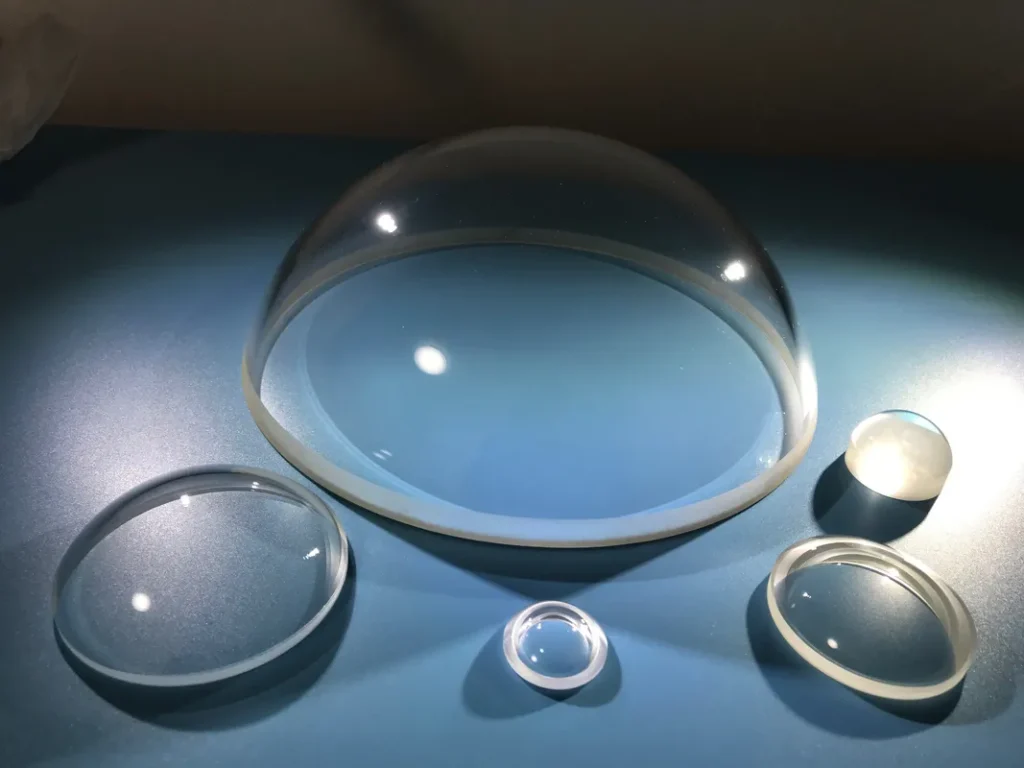
2. Sapphire Flat Optical Window
A sapphire flat window consists of two parallel polished sapphire surfaces.
Optiska egenskaper
Flat sapphire windows are primarily used for direct transmission and environmental sealing.
Due to sapphire’s high refractive index, reflection losses at each interface can be significant:
R=(n1+n2n1−n2)2
At air–sapphire interfaces, this results in approximately ~7–8% reflection per surface without anti-reflective coatings.
Viktiga funktioner
- Minimal optical distortion at normal incidence
- Simple geometry and high manufacturability
- Excellent for laser systems and controlled optical paths
- Limited performance under wide-angle viewing conditions
Begränsningar
- Strong angular dependence of refraction
- Increased optical aberration at oblique incidence
- Not ideal for hemispherical or wide-FOV imaging
3. Sapphire Optical Dome
A Optisk kupol av safir is a hemispherical or near-hemispherical shell made from single-crystal sapphire.
It is specifically designed so that incoming rays strike the surface at near-normal incidence across a wide field of view.
Optical Advantages
- Minimizes angular refraction variation
- Reduces image distortion in wide-FOV systems
- Maintains more uniform optical path length
This is especially important in imaging systems where angular consistency is critical.
Mechanical Advantages of Sapphire Domes
Sapphire’s mechanical properties make domes particularly suitable for extreme environments:
- Hög tryckhållfasthet
- Excellent scratch resistance (suitable for abrasive environments like sand, water, or ice)
- Strong resistance to thermal shock
These properties allow sapphire domes to perform well in:
- Deep-sea imaging systems
- Aerospace and UAV sensors
- High-speed aerodynamic flow environments
4. Optical Performance Comparison (Sapphire-Based)
| Fastighet | Sapphire Flat Window | Sapphire Dome |
|---|---|---|
| Field of View | Narrow to moderate | Wide / hemispherical |
| Angular distortion | Increases with angle | Strongly minimized |
| Tryckbeständighet | Måttlig | Mycket hög |
| Optical uniformity | Angle-dependent | Highly uniform |
| Manufacturing complexity | Lägre | Högre |
5. Material-Specific Considerations for Sapphire
Unlike glass or fused silica, sapphire introduces additional design constraints:
5.1 Birefringence (Crystal Orientation Effect)
Sapphire is a uniaxial crystal, meaning optical performance depends on crystal orientation (C-axis alignment is critical).
5.2 Hardness and Machining Difficulty
- Requires diamond grinding and polishing
- Dome shaping significantly increases fabrication cost
5.3 Thermal Stability
Sapphire maintains optical stability at high temperatures (>1000°C), making it suitable for:
- Hypersonic windows
- Combustion chamber observation ports
6. Application Scenarios
Sapphire Flat Optical Windows
- Laser protection windows
- High-power optical isolators
- Industriella inspektionssystem
- Vacuum chamber viewports
Sapphire Optical Domes
- Höljen för undervattenskameror
- Missile and aerospace seeker windows
- High-speed UAV imaging systems
- Infrared wide-angle sensor protection
7. Slutsatser
In sapphire-based optical systems, the choice between a flat window and a dome is fundamentally a trade-off between optical simplicity and angular performance.
- Sapphire flat windows are optimal for controlled, narrow-field optical paths requiring high durability and clarity.
- Safir kupoler are essential for wide-angle imaging systems operating in extreme mechanical and environmental conditions.
As optical systems move toward higher integration, wider field-of-view imaging, and harsher operating environments, sapphire domes are becoming increasingly critical in next-generation aerospace, marine, and defense applications.