
Sapphire (single-crystal aluminum oxide, Al₂O₃) and quartz (fused silica, SiO₂) are two widely used materials in optical and industrial windows, each offering distinct advantages in thermal, mechanical, and optical performance. Understanding their differences is crucial for selecting the right window material for demanding applications in aerospace, semiconductor processing, high-power lasers, and harsh-environment instrumentation.
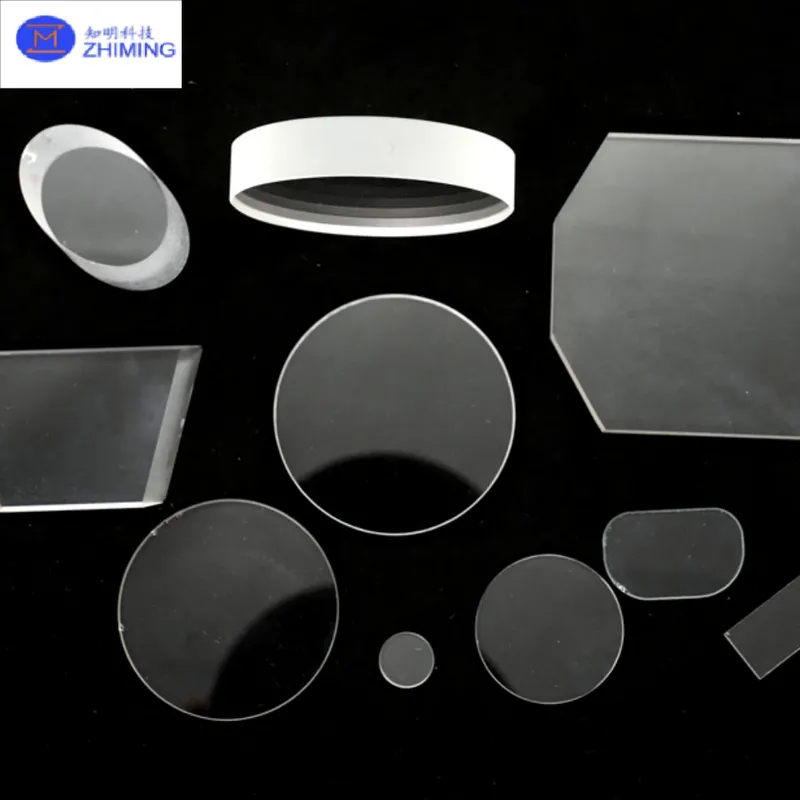
1. Optical Transparency
Sapphire windows exhibit excellent optical transmission across a broad spectral range, from ultraviolet (≈150 nm) to near-infrared (≈5500 nm). Their high refractive index (~1.76) enables efficient light propagation while minimizing distortion, making them ideal for high-precision optical systems. Quartz windows also offer high transparency, particularly in the ultraviolet (≈180 nm) to near-infrared (≈2500 nm) range, with slightly lower refractive index (~1.46). For applications requiring UV transmission below 200 nm, quartz is generally preferred due to its superior deep-UV transparency.
2. Thermal Stability
Sapphire windows demonstrate exceptional thermal resistance, with a melting point above 2,030°C and thermal conductivity around 35 W/m·K at room temperature. This allows them to maintain structural integrity and optical clarity under high-temperature conditions, making them suitable for high-power laser windows and furnace viewports. Quartz windows, while capable of withstanding temperatures up to approximately 1,100°C in continuous use, have lower thermal conductivity (~1.4 W/m·K) and are more susceptible to thermal stress cracking under rapid temperature changes.
3. Mechanical Strength and Hardness
Sapphire is extraordinarily hard, ranking 9 on the Mohs scale, second only to diamond. Its high hardness and fracture toughness (2–4 MPa·m¹/²) provide excellent resistance to scratching, abrasion, and mechanical impact. This makes sapphire windows highly durable in abrasive or high-pressure environments. Quartz, with a Mohs hardness of 7 and lower fracture toughness (~0.7 MPa·m¹/²), is more prone to surface damage under mechanical stress, though it remains adequate for many standard laboratory and optical applications.
4. Chemical Resistance
Both sapphire and quartz exhibit strong chemical inertness. Sapphire is resistant to most acids, alkalis, and organic solvents, except for hot concentrated phosphoric acid and hydrofluoric acid. Quartz, while also chemically stable, is more sensitive to hydrofluoric acid, which can etch its surface. For applications involving aggressive chemical exposure, sapphire generally provides superior long-term reliability.
5. Cost and Fabrication Considerations
Sapphire windows are more expensive due to the complexity of single-crystal growth and precision polishing. They often require specialized fabrication techniques such as chemical-mechanical polishing (CMP) to achieve optical-grade surfaces. Quartz windows are relatively more cost-effective and easier to produce in large sizes, making them suitable for applications where extreme mechanical or thermal performance is not critical.
Conclusion
Selecting between sapphire and quartz windows depends on the specific performance requirements:
- Sapphire windows are preferred when high mechanical strength, thermal stability, and chemical resistance are essential. Ideal for high-power lasers, harsh environments, and high-precision optical systems.
- Quartz windows are suitable when ultraviolet transparency, cost-effectiveness, and moderate thermal conditions are priorities. Commonly used in standard optics, photolithography, and general laboratory instrumentation.
By carefully considering optical, thermal, mechanical, and chemical properties, engineers and researchers can optimize window selection for reliability and long-term performance, ensuring both safety and efficiency in demanding industrial and scientific applications.