
Sapphire windows are critical components in high-tech industries, including optics, aerospace, and chemical processing. Despite their apparent simplicity—a flat, transparent piece of material—the performance of sapphire windows depends heavily on their precise specifications. For junior procurement officers, understanding a sapphire window specification sheet is essential to ensure material compatibility, avoid costly mistakes, and optimize procurement processes.
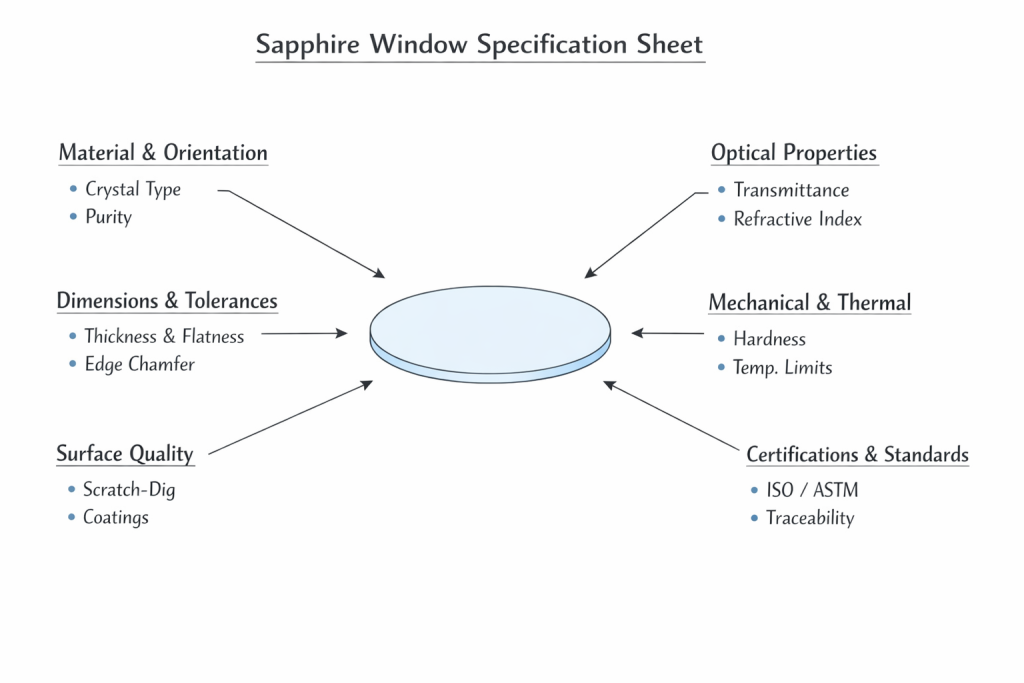
Understanding Material Composition and Purity
Sapphire, or single-crystal aluminum oxide (Al₂O₃), is prized for its hardness, chemical stability, and optical clarity. Specification sheets often list the crystal orientation, impurity levels, and optical grade. For procurement purposes, attention should be paid to:
- Crystal Orientation (C-plane, A-plane, R-plane): Determines mechanical strength and optical properties.
- Impurity Content: Low impurity levels reduce optical absorption and improve thermal performance.
- Optical Grade: Defines light transmittance and surface quality, critical for laser or UV applications.
Dimensions and Tolerances
Dimensional accuracy directly affects the window’s fit and performance. Specification sheets typically provide:
- Thickness and Diameter/Width: Measured in millimeters, with tolerances indicating allowable variation.
- Flatness and Parallelism: Affect optical clarity and sealing effectiveness in pressure environments.
- Edge Chamfer or Bevel: Important for mounting and minimizing stress concentration.
Junior procurement officers should verify that the tolerances meet the requirements of the target equipment, especially in high-precision optics or vacuum systems.
Optical Properties
Sapphire windows often serve as transparent barriers, and their optical characteristics are critical:
- Transmittance Range: Indicates the wavelength range over which the window allows light to pass, usually from UV to IR regions.
- Refractive Index: Influences lens or window assembly design.
- Birefringence: Some applications are sensitive to light polarization, so low-birefringence windows may be required.
Procurement officers should correlate optical properties with the intended application, such as laser systems, spectrometers, or observation ports.
Mechanical and Thermal Specifications
Sapphire’s extreme hardness and thermal stability make it suitable for harsh environments. Key parameters include:
- Mohs Hardness: Typically around 9, ensuring scratch resistance.
- Maximum Operating Temperature: Indicates the thermal limits for continuous use.
- Thermal Expansion Coefficient: Important when mating with metals or ceramics to prevent cracking.
Verifying these specifications prevents mechanical failure and extends the service life of the component.
Surface Quality and Coatings
Surface finish and coatings can significantly affect performance:
- Scratch-Dig: A standard notation (e.g., 10-5) describing allowable surface imperfections.
- Anti-Reflective (AR) Coating: Reduces reflection losses, critical for optical systems.
- Protective Coatings: Enhance chemical resistance or reduce surface contamination.
Procurement officers should ensure that surface quality and coatings match operational requirements.
Interpreting Certification and Compliance
Many specification sheets include testing standards, certificates of compliance, or material traceability. Items to check:
- ISO or ASTM Standards: Indicate adherence to recognized testing protocols.
- Batch Traceability: Useful for high-reliability applications.
- Supplier Recommendations: Ensure proper handling, cleaning, and installation procedures.
Conclusion
A sapphire window may appear deceptively simple, but its performance is highly dependent on precise material, optical, and mechanical specifications. For junior procurement officers, developing the ability to read and interpret specification sheets is crucial. By systematically analyzing material composition, dimensions, optical properties, mechanical limits, surface quality, and compliance certifications, procurement professionals can make informed decisions, reduce procurement risks, and contribute to the reliable operation of high-tech systems.