
Rectangular sapphire windows are widely used in optical sensors, industrial inspection systems, semiconductor equipment, laser systems, high-pressure instruments and harsh-environment viewing assemblies.
Compared with circular sapphire windows, rectangular windows can make better use of available installation space and provide a larger usable field of view. However, their geometry also creates several additional engineering challenges.
The most important are:
- Corner stress concentration
- Corner radius selection
- Ébréchure des arêtes
- Unsupported span
- Épaisseur de la vitre
- Planéité
- Parallélisme
- Mounting-seat accuracy
- Clamping stress
- Incompatibilité de dilatation thermique
A rectangular sapphire window should therefore not simply be treated as a circular window with four sides removed.
Its mechanical design, optical specifications and mounting method should be evaluated together.
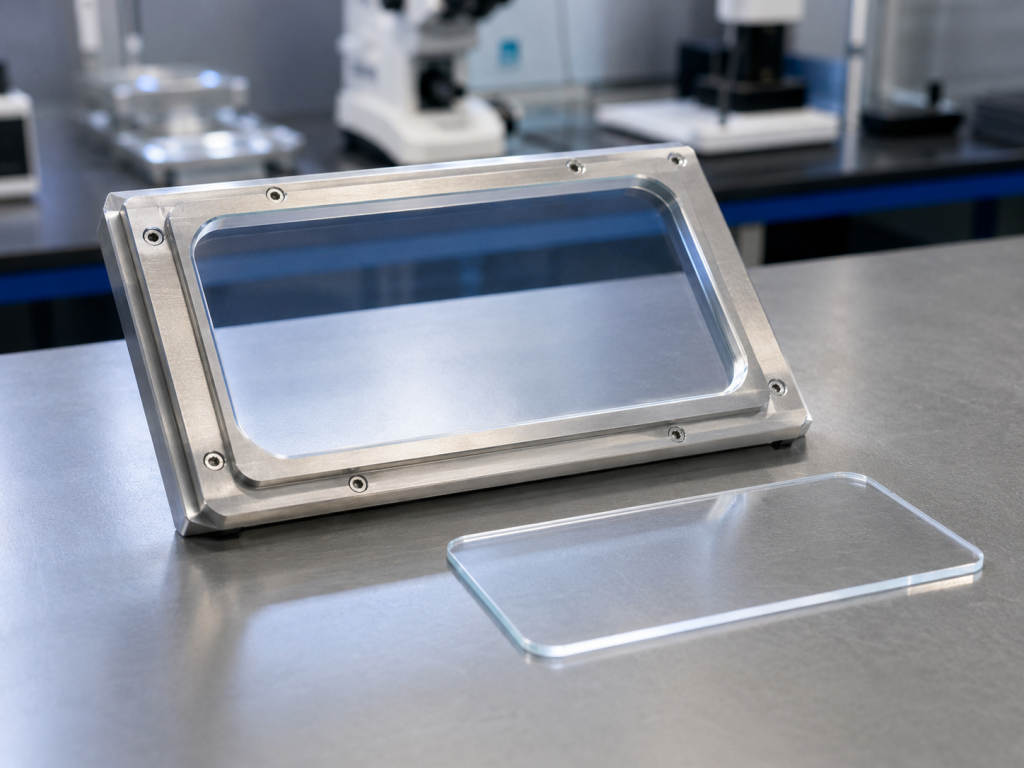
1. Why Use a Rectangular Sapphire Window?
Rectangular and square sapphire windows are commonly selected when the optical opening or equipment housing is not circular.
Les applications typiques sont les suivantes
- Camera protection windows
- Systèmes de vision industrielle
- Capteurs optiques
- Équipements laser
- Chambres à vide
- Équipements de traitement des semi-conducteurs
- Furnace observation windows
- High-pressure viewing systems
- Aerospace optical assemblies
- Harsh-environment displays
- Instruments scientifiques
A rectangular window can provide a larger clear aperture within a limited enclosure.
For example, if an optical sensor requires a wide horizontal field of view, a rectangular sapphire window may use the available space more efficiently than a circular component.
However, this advantage comes with a mechanical tradeoff.
A rectangular plate does not distribute stress as uniformly as a circular plate.
2. Why Are the Corners Important?
The corners are one of the most critical areas of a rectangular sapphire window.
Sharp internal or external geometric transitions tend to increase local stress.
This becomes particularly important because sapphire is a hard but brittle single-crystal material.
Unlike many metals, sapphire cannot relieve local stress through significant plastic deformation.
If a small machining flaw exists near a highly stressed corner, the combination of:
defect + tensile stress
can increase the probability of crack initiation.
For this reason, rectangular sapphire windows are often manufactured with controlled corner radii rather than perfectly sharp corners.
3. Corner Radius and Stress Concentration
Consider two rectangular sapphire windows with identical overall dimensions and thickness.
Design A
50 × 30 × 3 mm
Corner radius: R0.2 mm
Design B
50 × 30 × 3 mm
Corner radius: R3 mm
Although their overall size is almost identical, their mechanical behavior may differ.
The larger corner radius provides a smoother geometric transition and can reduce local stress concentration.
This does not mean that every rectangular window should use the largest possible radius.
Corner radius must also match:
- Housing geometry
- Ouverture effective
- Optical field of view
- Sealing structure
- Available mounting space
Therefore, corner radius is normally an engineering compromise between mechanical reliability and usable optical area.
4. Do Not Specify “Sharp Corners” Unless They Are Truly Necessary
Engineering drawings sometimes specify rectangular sapphire windows with extremely small corner radii because the designer wants to maximize clear aperture.
This can create manufacturing and reliability problems.
Sapphire is typically shaped using diamond grinding and precision machining.
Producing an extremely sharp corner can increase the difficulty of:
- Grinding
- Polissage
- Edge finishing
- Handling
- Inspection
It can also make the corner more vulnerable to chipping.
If a truly sharp corner is not required by the assembly, allowing a reasonable radius can improve manufacturability and reduce damage risk.
A better RFQ may specify:
4 × R1.0 mm
rather than simply:
Corners sharp
unless the optical or mechanical design genuinely requires sharp geometry.
5. Corner Radius Is Different From Edge Chamfer
These two specifications should not be confused.
Corner Radius
The radius viewed from the front surface of the rectangular window.
Exemple :
R2 mm at four corners
Edge Chamfer
The bevel applied around the thickness direction of the component.
Exemple :
0.3 × 45° chamfer
A rectangular sapphire window may therefore simultaneously have:
- Four R2 mm plan-view corners
- A 0.3 mm edge chamfer around its perimeter
Both parameters influence manufacturing and handling performance.
6. Edge Stress Is Often More Important Than the Center
Under mechanical loading, the highest stress region depends on:
- Window geometry
- Support structure
- Pressure
- Épaisseur
- Ouverture effective
- Conditions de montage
For rectangular windows, edges and corners deserve particular attention.
Potential edge-related defects include:
- Chips
- Microfissures
- Traces de meulage
- Dommages souterrains
- Uneven bevels
- Local scratches
A small defect in a highly stressed area can reduce the practical strength of the finished component.
This is why edge quality should be included in the specification for structural or pressure-loaded sapphire windows.
7. Edge Finish Options for Rectangular Sapphire Windows
Depending on the application, the perimeter may be supplied with:
Ground Edge
Suitable for applications where the edge is not optically active.
This is normally the most economical option.
Fine-Ground Edge
Provides improved edge finish and may reduce visible machining damage.
Polished Edge
Used when:
- The edge is optically active
- High cosmetic quality is required
- Internal reflection behavior matters
- The application has strict cleanliness requirements
Chamfered Edge
A small chamfer helps remove fragile sharp edges and improves handling.
Rounded Edge
A controlled radius may be used for specialized mechanical designs.
The correct option depends on the mounting and optical function.
8. Clear Aperture Should Be Defined Separately
For rectangular sapphire windows, the outside dimensions and optical clear aperture should be treated as separate parameters.
Exemple :
Overall size:
50 × 30 mm
Ouverture effective :
44 × 24 mm
This leaves approximately 3 mm around the perimeter for mechanical support.
If the clear aperture is increased to:
48 × 28 mm
the supported edge becomes much narrower.
That may affect:
- Bending stress
- Mounting reliability
- Seal width
- Edge loading
- Fracture safety factor
Therefore, maximizing clear aperture is not always mechanically desirable.
9. Thickness Depends on Unsupported Span
A common mistake is choosing sapphire thickness only from the overall length and width.
The real mechanical loading depends strongly on the unsupported opening.
Consider:
Window A
Sapphire size: 60 × 40 mm
Opening: 40 × 20 mm
Window B
Sapphire size: 60 × 40 mm
Opening: 56 × 36 mm
Although the sapphire dimensions are identical, Window B has a much larger unsupported area.
Its bending stress and deflection may therefore be significantly greater.
For pressure-loaded applications, the supplier or mechanical engineer should evaluate:
- Unsupported length
- Unsupported width
- Épaisseur du saphir
- Différence de pression
- Boundary condition
- Température
- Coefficient de sécurité
10. Rectangular Windows Behave Differently From Circular Windows
Circular windows are naturally symmetrical.
When uniformly loaded and evenly supported, stress tends to distribute around the circumference in a relatively predictable way.
Rectangular windows introduce:
- Long and short axes
- Corners
- Different bending distances
- Unequal edge conditions
Therefore, a thickness selected for a circular sapphire window of a similar area should not automatically be copied to a rectangular design.
For high-pressure or safety-critical applications, mechanical calculation or finite element analysis may be appropriate.
11. Flatness Requirements
Flatness describes how much the optical surface deviates from an ideal plane.
Typical specifications may be expressed as:
- λ
- λ/2
- λ/4
- λ/10
at a specified reference wavelength.
The required flatness depends heavily on the application.
For a protective camera window, extremely tight flatness may not be necessary.
For:
- Imagerie de précision
- Interférométrie
- Systèmes laser
- Beam delivery
tighter flatness may be important.
12. Do Not Over-Specify Flatness
Tighter flatness generally increases manufacturing difficulty and cost.
A buyer should therefore avoid specifying:
planéité de λ/10
simply because it appears better than:
λ/4
If the application only requires a protective optical cover, the tighter specification may provide little practical benefit.
A more economical design specifies only the performance required by the optical system.
13. Large Rectangular Windows Are More Difficult to Keep Flat
As sapphire window dimensions increase while thickness remains constant, controlling flatness generally becomes more challenging.
A thin rectangular plate can be more sensitive to:
- Grinding stress
- Polishing stress
- Handling
- Mounting force
- Thermal gradients
For large windows, engineers may need to balance:
Épaisseur
against
Weight + cost + transmission + flatness + mechanical strength
Increasing thickness may improve mechanical rigidity, but it also increases raw material and machining cost.
14. Parallelism and Wedge
Flatness and parallelism are different parameters.
Planéité
Describes the shape of an individual surface.
Parallélisme
Describes the angular relationship between the two major surfaces.
If the surfaces are not sufficiently parallel, the window effectively behaves like a weak prism.
Cela peut entraîner :
- Déviation du faisceau
- Décalage de l'image
- Alignment errors
For laser systems, parallelism or wedge should therefore be specified according to optical requirements.
15. Mounting Design Is Critical
Many sapphire window failures occur not during manufacturing but after installation.
A well-manufactured rectangular sapphire window can be damaged by:
- Uneven clamping
- Distorted housing
- Metal burrs
- Excessive bolt torque
- Point contact
- Dilatation thermique
- Improper gasket geometry
The mounting system should distribute load as evenly as possible.
16. Avoid Point Loading at the Corners
Corners should not carry concentrated mechanical loads.
For example, a retaining frame that contacts only four small areas near the corners can create severe local stress.
A better design generally distributes load over a wider region.
Possible mounting approaches include:
- Continuous retaining frame
- O-ring support
- Engineered gasket
- Flexible adhesive
- Compliant intermediate layer
The exact method depends on:
- Pressure
- Vacuum
- Température
- Exposition à des substances chimiques
- Optical requirements
17. O-Ring Mounting
O-rings are commonly used when sealing and mechanical compliance are both required.
A properly designed O-ring can:
- Provide sealing
- Prevent direct metal-to-sapphire contact
- Accommodate small dimensional variation
- Distribute load
However, excessive O-ring compression can also create stress.
Important parameters include:
- O-ring diameter
- Groove depth
- Compression ratio
- Material hardness
- Temperature capability
- Compatibilité chimique
The O-ring groove should therefore be designed as part of the overall mechanical assembly.
18. Retaining Frames and Clamping
A rectangular retaining frame is another common mounting method.
The frame should not force the sapphire to conform to an inaccurate mounting surface.
Avoid situations where:
- One corner contacts first
- Housing flatness is poor
- Fasteners are tightened unevenly
- Metal directly touches a sharp sapphire edge
For bolted frames, a controlled tightening sequence may help distribute load more uniformly.
19. Housing Flatness Matters
If the mounting surface is warped, tightening the retaining structure can bend the sapphire.
This may create residual stress before the equipment is even operated.
For precision or heavily loaded assemblies, consider specifying:
- Mounting-seat flatness
- Frame flatness
- Parallélisme
- Finition de surface
The window and housing should be treated as a mechanical system.
20. Allow for Thermal Expansion
Sapphire and metal housings expand differently as temperature changes.
This becomes important in:
- Furnace equipment
- Chambres à vide
- Traitement des semi-conducteurs
- Capteurs de haute température
- Systèmes laser
If a sapphire window is tightly constrained by a metal frame, heating can generate additional stress.
The design should therefore provide sufficient compliance for expected thermal movement.
This becomes even more important for large rectangular windows because dimensional changes along the long axis can be greater.
21. Adhesive-Bonded Rectangular Sapphire Windows
Adhesives are often used where mechanical clamps are undesirable.
Potential advantages include:
- Continuous support
- Simplified housing
- Sealing capability
- Reduced metal contact
However, adhesive systems must be carefully selected.
Consider:
- Température de fonctionnement
- Cure shrinkage
- Elastic modulus
- Bond-line thickness
- Outgassing
- Résistance chimique
- Incompatibilité de dilatation thermique
For vacuum applications, adhesive outgassing must also be considered.
22. Surface Quality Requirements
Typical optical sapphire surface-quality specifications include:
- 80-50
- 60-40
- 40-20
- 20-10
- 10-5
The correct requirement depends on the optical system.
For ordinary protective windows, specifying 10-5 may unnecessarily increase cost.
Higher quality becomes more important for:
- Lasers à haute puissance
- Imaging
- Inspection optics
- Instruments scientifiques
- Scattering-sensitive systems
The clear aperture should also be stated together with the surface-quality requirement.
23. AR Coating Considerations
Uncoated sapphire surfaces reflect part of the incident light.
For systems requiring higher transmission, an anti-reflection coating may be applied.
Common design ranges include:
- UV
- Visible
- Proche infrarouge
- Specific laser wavelengths
En voici quelques exemples :
355 nm
532 nm
1064 nm
or broadband ranges such as:
400-700 nm
The RFQ should provide the actual operating wavelength rather than simply requesting:
“AR coating.”
24. Typical Rectangular Sapphire Window Specification
A practical RFQ could look like this:
Material: Optical-grade single-crystal sapphire
Shape: Rectangulaire
Size: 50 × 30 mm
Épaisseur : 3 mm
Corner radius: 4 × R2 mm
Edge: 0.3 × 45° chamfer
Surface: Double-side polished
Qualité de la surface : 20-10
Flatness: λ/4 @ 632.8 nm
Parallelism: ≤ 3 arc min
Ouverture effective : ≥ 90%
Coating: AR 400–700 nm
Quantity: 100 pcs
This is much more useful to a manufacturer than simply specifying:
50 × 30 × 3 mm sapphire glass.
25. Rectangular Sapphire Window RFQ Checklist
When requesting a quotation, provide the following information.
Dimensions
- Length
- Width
- Épaisseur
- Dimensional tolerance
- Rayon de courbure
Edge
- Chanfrein
- Bevel
- Radius
- Bord meulé ou poli
- Maximum allowable edge chip
Optical
- Qualité de surface
- Planéité
- Parallélisme
- Rugosité de surface
- Ouverture effective
- Longueur d'onde de fonctionnement
- AR coating
Matériau
- Sapphire grade
- Crystal orientation, if required
Mechanical
- Ouverture non prise en charge
- Différence de pression
- Méthode de montage
- Matériau du boîtier
Environnement
- Température de fonctionnement
- Cycles thermiques
- Niveau de vide
- Process gas
- Exposition à des substances chimiques
Commercial
- Prototype quantity
- Quantité produite
- Annual demand
Providing these parameters early can significantly reduce design revisions and quotation uncertainty.
26. Common Design Mistakes
Mistake 1: Specifying Perfectly Sharp Corners
Unless required by the assembly, a small radius usually provides better manufacturability.
Mistake 2: Ignoring Edge Chips
Edge defects can become critical under mechanical load.
Mistake 3: Maximizing Clear Aperture Without Considering Support
A larger opening means less supported perimeter.
Mistake 4: Selecting Thickness Only From Outside Dimensions
Unsupported span is often more important.
Mistake 5: Over-Specifying Flatness
Tighter optical tolerances increase cost and should be justified by system requirements.
Mistake 6: Clamping the Window Directly Between Hard Metal Surfaces
This can create concentrated mounting stress.
Mistake 7: Ignoring Housing Flatness
A warped mounting surface can bend the sapphire during installation.
Conclusion
Rectangular sapphire windows provide an excellent combination of optical transparency, hardness, thermal resistance and environmental durability for demanding optical systems.
However, their geometry requires more careful mechanical design than many simple circular windows.
The most important considerations include:
Corner radius + edge quality + unsupported span + thickness + flatness + mounting stress.
Sharp corners and damaged edges can create stress concentrations.
Excessive clear aperture can reduce mechanical support.
Poor housing flatness or uneven clamping can introduce stress even before the equipment begins operating.
For this reason, the best rectangular sapphire window specification should define not only length, width and thickness, but also:
- Rayon de courbure
- Condition aux bords
- Ouverture effective
- Planéité
- Parallélisme
- Méthode de montage
- Pressure
- Température
Designing the sapphire window together with its housing and operating environment usually provides better reliability than treating the optical component as an isolated plate.
FAQ
Why do rectangular sapphire windows usually have rounded corners?
Rounded corners help improve manufacturability and can reduce local stress concentration compared with extremely sharp corners. The correct radius depends on the housing and optical clear-aperture requirements.
What corner radius should I use for a rectangular sapphire window?
There is no universal value. The radius should be selected based on window size, thickness, clear aperture, mounting structure and mechanical loading. If the design allows it, avoiding unnecessarily sharp corners generally improves manufacturing robustness.
Does a rectangular sapphire window need a chamfer?
A small chamfer is often useful because it removes fragile sharp edges and reduces handling damage. The required chamfer should be specified on the drawing.
What determines the required sapphire window thickness?
Important factors include unsupported aperture, length-to-width ratio, pressure differential, mounting condition, temperature and required safety factor. Outside dimensions alone are not sufficient.
Can rectangular sapphire windows be AR coated?
Yes. Sapphire windows can be coated for UV, visible, NIR or specific laser wavelengths. The coating specification should include the actual operating wavelength or wavelength range.
Why can a sapphire window crack after installation?
Possible causes include edge damage, uneven clamping, point loading, housing distortion, excessive gasket compression and thermal expansion mismatch. The mounting system should therefore be evaluated together with the sapphire component.