
Synthetic sapphire is a single-crystal form of aluminum oxide (Al₂O₃), known for its extreme hardness and mechanical robustness.
Die wichtigsten Merkmale sind:
- Very high hardness (near diamond scale)
- Strong resistance to abrasion and surface wear
- High thermal conductivity compared to most optical glasses
- Stable chemical resistance under harsh environments
From an engineering perspective, sapphire behaves more like a structural optical material, where mechanical integrity is often as important as optical transmission.
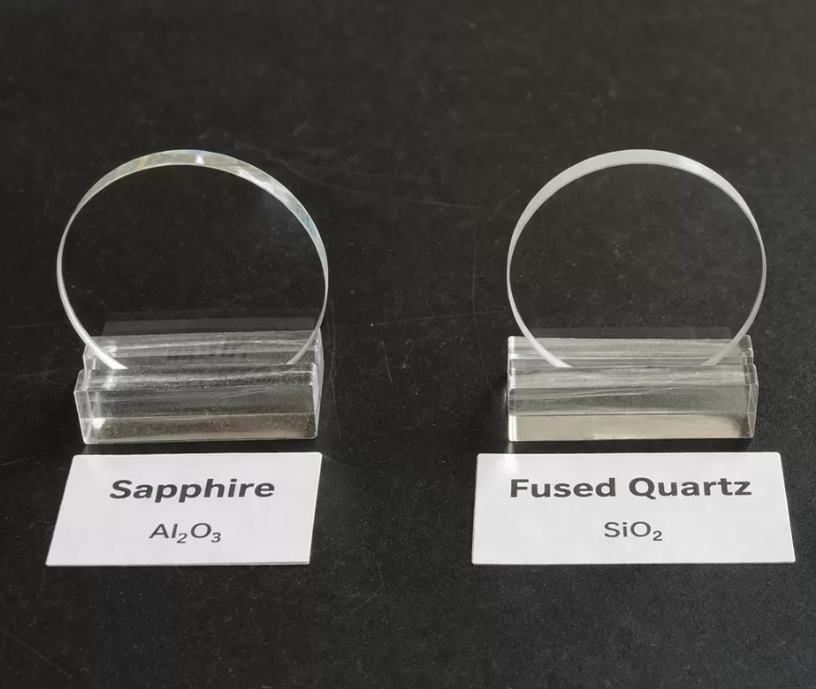
Fused Silica: Optical Purity and Thermal Stability
Fused silica is an amorphous form of silicon dioxide (SiO₂) with extremely high chemical purity and excellent optical transmission across a wide spectral range.
Its key advantages include:
- Extremely low thermal expansion
- Excellent UV to near-infrared transmission
- Hohe optische Homogenität
- Strong resistance to thermal shock
Unlike sapphire, fused silica is primarily optimized for optical precision rather than mechanical durability.
Where Sapphire Can Replace Fused Silica: A Cross-Industry Perspective
High-Power Laser and Photonic Systems
One of the most significant substitution areas is in high-energy laser systems.
Sapphire exhibits a higher laser damage threshold compared to fused silica, making it more suitable for:
- High-power laser output windows
- Laser cavity protection components
- Optical interfaces exposed to intense pulsed irradiation
In such environments, surface damage and thermal deformation are critical failure modes, and sapphire’s mechanical resilience provides a clear advantage.
Semiconductor and Vacuum Processing Equipment
In advanced semiconductor manufacturing, optical components must operate under vacuum, plasma exposure, and high thermal loads.
Sapphire is increasingly used in:
- Vacuum chamber viewports
- Plasma-Beobachtungsfenster
- Deposition system inspection ports
Compared to fused silica, sapphire offers better resistance to ion bombardment and surface degradation in aggressive processing environments.
Infrared and Harsh-Environment Optics
Sapphire is widely applied in infrared sensing and defense-related optical systems, particularly where mechanical durability is critical.
Die Anwendungen umfassen:
- IR sensor protective windows
- Missile and aerospace optical domes
- High-vibration optical platforms
While fused silica provides broader spectral transmission in UV/visible regions, sapphire performs better in mechanically demanding infrared environments.
Medical and Bioengineering Devices
In biomedical engineering, sapphire is increasingly used in precision and implantable systems due to its biocompatibility and wear resistance.
Beispiele hierfür sind:
- Surgical cutting tools with ultra-sharp edges
- Protective housings for implantable sensors
- Optical windows in diagnostic instruments
Its hardness enables long-term stability in contact-based medical environments where fused silica may suffer surface degradation.
Consumer Electronics and Precision Optics
Sapphire has become a premium material in consumer devices requiring scratch resistance and long-term optical clarity.
Common applications include:
- Smartphone-Kameraobjektivabdeckungen
- High-end wristwatch crystals
- Ultra-thin protective optical covers
In these cases, sapphire replaces conventional glass or silica-based components where mechanical wear is the dominant failure mechanism.
Aerospace and Extreme Environment Systems
In aerospace applications, sapphire is used in:
- High-temperature observation windows
- Flame detection sensor windows
- Optical components exposed to aerodynamic heating
Its ability to maintain structural integrity under thermal and mechanical stress makes it suitable for environments where fused silica may experience deformation or fracture.
Why Fused Silica Still Cannot Be Fully Replaced
Despite its advantages, sapphire does not universally replace fused silica due to several intrinsic limitations:
- Lower performance in deep UV transmission compared to high-purity silica
- Higher material and processing cost
- More complex precision machining requirements
- Anisotropic crystal behavior affecting optical uniformity
Therefore, fused silica remains dominant in:
- Photolithography systems
- UV optical instruments
- Precision metrology equipment
- Broadband optical systems requiring minimal birefringence
Material Selection Logic: A System-Level Engineering Decision
The choice between sapphire and fused silica is not simply a material substitution problem, but a system-level optimization problem involving:
- Optical wavelength requirements
- Mechanical load conditions
- Thermal environment stability
- Manufacturing feasibility
- Lifecycle cost analysis
In modern engineering design, sapphire is increasingly selected not because it is “better overall,” but because it is more robust in extreme operational conditions.
Conclusion: From Optical Transparency to Functional Survivability
The evolution of optical window materials reflects a broader trend in advanced engineering: materials are no longer selected solely for optical performance, but for their ability to survive and function under multi-physics extreme conditions.
Sapphire is emerging as a strong candidate for replacing fused silica in mechanically and thermally demanding environments, while fused silica continues to dominate in precision optical and broadband transmission systems.
Rather than a complete substitution, the future will likely be defined by application-specific hybrid material strategies, where each material occupies a distinct functional niche.
FAQ
Is synthetic sapphire always better than fused silica for optical applications?
No. Synthetic sapphire offers superior hardness, wear resistance, and higher laser damage threshold, but fused silica performs better in deep UV transmission, optical homogeneity, and low birefringence. The “better” choice depends entirely on the operating environment and wavelength requirements.
Why is sapphire more suitable for harsh or high-energy environments?
Sapphire has excellent mechanical strength, high thermal conductivity, and strong resistance to abrasion, plasma, and ion bombardment. These properties allow it to maintain structural integrity in high-power laser systems, vacuum chambers, and aerospace conditions where fused silica may degrade or deform.
What are the main limitations of using sapphire compared to fused silica?
Sapphire is more expensive and harder to machine due to its crystal structure. It also has anisotropic optical properties, which can affect precision optical performance, and it does not perform as well in deep UV transmission compared to high-purity fused silica.