
In high-precision optical and industrial equipment, the choice of window material plays a critical role in system performance, reliability, and longevity. Among the most commonly used materials are fused quartz and sapphire. Both materials exhibit excellent optical transparency, thermal stability, and chemical resistance, but they differ significantly in mechanical strength, cost, and application suitability.
1. Optical Transparency and Transmission Range
- Quartz Windows: Fused quartz offers excellent transmission across a wide spectral range, typically from 200 nm (ultraviolet) to 3.5 μm (infrared). This makes quartz windows highly suitable for UV spectroscopy, laser systems, and photolithography.
- نوافذ الياقوت: Sapphire provides slightly lower UV transmission (down to ~150 nm) but excels in visible to mid-infrared transparency, extending to around 5 μm. Its high refractive index can be advantageous in optical design where minimal distortion and high transmittance are required.
2. Mechanical Strength and Durability
- Quartz: While quartz is relatively hard (Mohs hardness ~7) and resistant to scratching, it remains more brittle than sapphire and is prone to fracture under mechanical stress.
- Sapphire: With a Mohs hardness of 9, sapphire is nearly as hard as diamond and highly resistant to abrasion, making it ideal for harsh environments, high-pressure applications, and protective windows in semiconductor, aerospace, and laser systems.
3. Thermal and Chemical Resistance
- Quartz: Fused quartz withstands temperatures up to 1,100°C and exhibits low thermal expansion, which minimizes optical distortion under thermal cycling. It is also highly resistant to most acids and bases.
- Sapphire: Sapphire surpasses quartz in thermal tolerance, withstanding up to 2,000°C in some conditions. Its chemical inertness is exceptional, resisting strong acids, alkalis, and corrosive gases, which is particularly valuable in semiconductor processing and chemical instrumentation.
4. Manufacturing and Customization
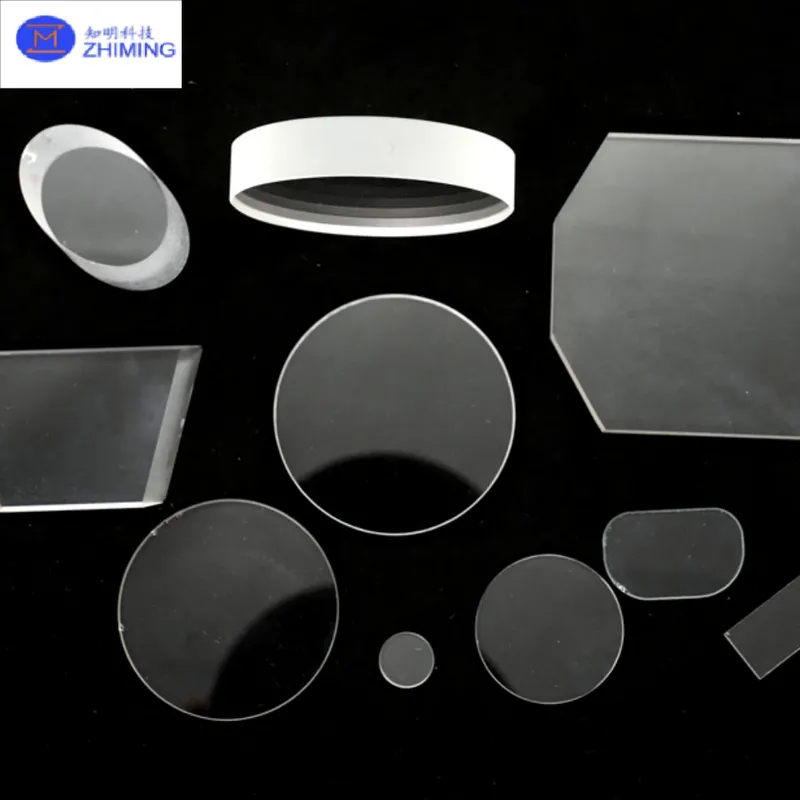
- Quartz: Easier to machine and polish to high precision, quartz windows can be produced in a variety of shapes and sizes at a lower cost. Its surface flatness and thickness tolerances are excellent for high-precision optical assemblies.
- Sapphire: While more challenging and expensive to fabricate due to its hardness, sapphire can be produced as thin, large-diameter windows (including 8-inch and 12-inch wafers) with high optical quality. Surface polishing and edge finishing require specialized techniques, which increases manufacturing costs.
5. Cost vs. Performance Considerations
- Quartz Windows: More cost-effective for applications that require UV transparency, moderate mechanical strength, and stable thermal performance. Widely used in research, optical instruments, and general industrial environments.
- Sapphire Windows: Premium material with superior mechanical and chemical resilience. Best suited for extreme environments, high-pressure windows, protective covers for sensors, and high-power laser applications. The higher cost is often justified by increased longevity and reduced maintenance.
Conclusion
Both quartz and sapphire windows offer distinct advantages. Quartz is optimal for cost-sensitive optical applications requiring UV transparency and precision flatness, while sapphire is the material of choice for extreme mechanical, thermal, and chemical conditions. Selecting the appropriate window material requires careful consideration of optical requirements, environmental conditions, and long-term durability.